
When Did It Become Acceptable to Bash Disabled Women?
When Did It Become Acceptable to Bash Disabled Women?
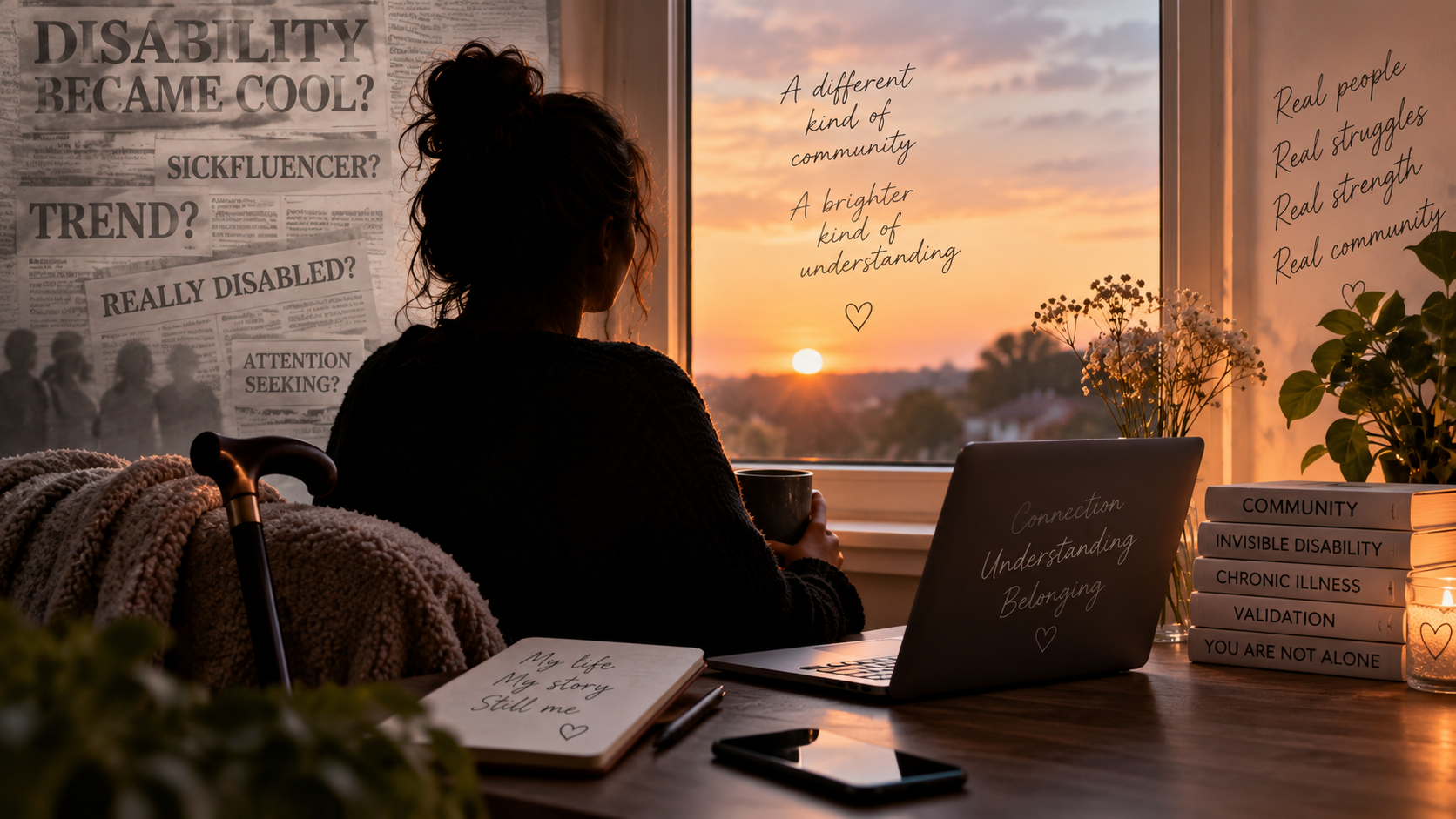
I recently read an article in The Telegraph titled “How having a disability became cool”, and I have to say that it left me feeling angry, disappointed and actually quite sad.
Not because disability should be above discussion or criticism. Not because everything somebody says about chronic illness on social media should automatically be accepted without question. There absolutely should be conversations about misinformation, inappropriate medical advice and people exploiting vulnerable communities online.
That is not what bothers me.
What bothers me is the way disabled and chronically ill women seem to have become fair game.
As somebody who actually lives with ME/CFS, fibromyalgia, severe spinal foraminal narrowing, severe TMJ and mechanical back pain, I find the suggestion that disability has somehow become “cool” incredibly difficult to swallow.
These are not labels I collect or identities I wear because they make me interesting. They are conditions I live with every single day. They affect how I move, how much I can do, how I sleep, how I work and how I plan even the most ordinary parts of my life.
There is nothing “cool” about having to negotiate with your own body before deciding whether you have enough energy to do something. There is nothing fashionable about chronic pain, crushing fatigue, brain fog or having to think about the consequences of an activity that most people would never give a second thought to.
This is my reality. It is not a trend.
People see a photograph on social media. They see somebody smiling. They see somebody wearing nice clothes, putting on make up, going outside or perhaps using a walking stick or another mobility aid.
What they do not see is the rest of it.
They do not see what happened before that photograph was taken.
They do not see what happens afterwards.
They do not see the days spent recovering. They do not see the pain. They do not see the brain fog. They do not see the fatigue that is so much more than simply feeling tired.
When you live with ME/CFS, particularly with post exertional malaise, something that looks small to somebody else can have consequences that last long after the activity itself has finished.
That is part of the reality of living with fluctuating and invisible disabilities.
Perhaps this is why the article touched such a nerve with me.
I know what it is like to live inside a body that other people cannot fully see or understand.
Disability Is Not An Identity Trend
One of the things I found particularly uncomfortable about the article was the framing around young women, chronic illness and the idea that disability can become an identity or provide some kind of social status.
I find that troubling.
When disabled women find each other online, I do not automatically see people trying to make themselves interesting.
I see people trying to find each other.
There is a difference.
Living with chronic illness can shrink your world in ways that are incredibly difficult to explain to somebody who has never experienced it.
Your social life can change. Your work can change. Your relationships can change. Your independence can change. Even your relationship with yourself can change.
Things that used to be completely ordinary can suddenly require planning.
Going out for coffee.
Doing the shopping.
Having a shower.
Cleaning the house.
Meeting somebody for lunch.
Working for a few hours.
Sometimes I have to think about energy in a way that a healthy person probably never has to think about it. I cannot simply assume that because I want to do something, my body will cooperate.
That changes you.
It can also be incredibly lonely.
So when somebody with ME/CFS, fibromyalgia, PoTS or another chronic illness goes online and finds somebody saying, “I understand”, that can mean more than people realise.
That is not making disability cool.
That is finding human connection in circumstances that can otherwise feel painfully isolating.
The Loneliness Behind Chronic Illness Social Media Communities
This is the part I feel gets lost when people mock so called “sickfluencers”.
Behind the hashtags are human beings.
Behind the photographs are lives.
Behind the accounts are often people who have spent enormous amounts of time alone.
I think people underestimate the loneliness of chronic illness.
When you cannot participate in life in the same way as everybody else, social media can become a window into the world.
For somebody who is housebound, largely housebound, unable to work in a conventional environment or simply too unwell to socialise regularly, an online community can be incredibly important.
I do not think that should be mocked.
I think it should be understood.
I have written before about invisible disabilities because so much of the difficulty comes from the fact that people make judgements based on what they can see.
Fibromyalgia does not conveniently announce itself when I walk into a room.
ME/CFS does not put a sign above my head explaining what my body is dealing with.
Pain does not necessarily show on somebody's face.
Fatigue does not always photograph itself.
Brain fog cannot be seen in a selfie.
Post exertional malaise certainly cannot be measured by looking at somebody's Instagram account.
Yet somehow we still live in a world where disabled people are expected to look sufficiently disabled before some people will believe us.
Why Are Disabled Women Still Having To Prove They Are Ill?
This is where I feel there is a much bigger conversation to be had.
Women have spent generations trying to get their pain and symptoms taken seriously.
Many women living with chronic illness know what it feels like to wonder whether they are being believed.
We know what it feels like when symptoms are minimised.
We know the frustration of trying to explain something happening inside our bodies when there may be very little externally for somebody else to see.
This is why I find the suspicion directed towards chronically ill women so uncomfortable.
The Telegraph article itself discusses the reality that people with conditions such as PoTS can experience medical disbelief. Yet the wider framing then invites another kind of suspicion about women seeking diagnoses, sharing their experiences and building communities around chronic illness.
That contradiction bothers me.
If somebody has spent years trying to understand why they are unwell, finding other people experiencing similar symptoms can be incredibly validating.
Validation does not mean somebody on TikTok should diagnose another person.
Of course it does not.
Social media should never replace appropriate medical care.
I can believe that while also believing that chronic illness communities have enormous value.
The two things are not mutually exclusive.
There Is A Difference Between Questioning Misinformation And Questioning Disabled People
I think this distinction matters.
Medical misinformation should be challenged.
People giving dangerous health advice should be challenged.
People pretending to have medical qualifications they do not possess should be challenged.
Undisclosed advertising and exploitation should be challenged.
None of that requires us to create suspicion around disabled women themselves.
It does not require us to look at somebody using a mobility aid and wonder whether she really needs it.
It does not require us to treat multiple diagnoses as inherently suspicious.
It does not require us to assume that somebody talking openly about chronic illness has made illness their entire personality.
Most importantly, it does not require us to ridicule the communities disabled people have created because society has often failed to give them that same sense of belonging elsewhere.
Invisible Disability Means Exactly That
I sometimes wonder what people expect disability to look like.
Do I need to look miserable all the time to be believed?
Am I allowed to laugh?
Am I allowed to dress nicely?
Am I allowed to have a good day?
Am I allowed to post a photograph when I feel better without providing evidence of the days when I could barely function?
This is one of the cruel contradictions of invisible disability.
If I look unwell, I may be judged.
If I look well, I may not be believed.
There seems to be a very narrow idea of what a disabled person is supposed to look like, and those of us living with ME/CFS, fibromyalgia and other fluctuating conditions often fall outside it.
My health does not become less real because somebody cannot see it.
My pain does not disappear because I smiled for a photograph.
My fatigue does not cease to exist because I managed to do something that day.
One moment never tells the whole story.
Calling Disabled Women “Sickfluencers” Does Not Sit Comfortably With Me
I understand why the term attracts attention.
It is provocative.
It makes a good headline.
That does not mean I have to like what it reduces people to.
When I look at women sharing their experiences of chronic illness online, I do not see a single homogenous group called “sickfluencers”.
I see individual women.
Some will have large audiences.
Some will have fifty followers.
Some will be raising awareness.
Some will be documenting their lives.
Some will be trying to make sense of what has happened to them.
Some will simply want to talk to somebody who understands.
Are there problematic accounts online?
Of course.
There are problematic accounts in practically every corner of social media.
That does not mean an entire chronic illness community deserves to be viewed through a lens of suspicion.
What Looks Like Content To You Might Be A Lifeline To Somebody Else
This is what I wish more people understood.
A post that looks insignificant to somebody scrolling past it might reach somebody lying in bed who has not spoken to another person who understands their condition for months.
A woman talking about fibromyalgia might make somebody newly diagnosed feel less frightened.
A person describing post exertional malaise might finally give somebody the words to explain what has been happening to them.
A disabled woman showing herself using a mobility aid might make another young woman feel less embarrassed about needing one.
That matters.
Representation matters.
Community matters.
Feeling understood matters.
When illness has taken pieces of your old life away from you, finding people who understand your new reality can be incredibly powerful.
I struggle to see why that should be treated with contempt.
Living With ME/CFS And Fibromyalgia Changes How I Read Articles Like This
I cannot read commentary about chronic illness as a completely detached observer.
I live it.
I know what fatigue feels like when rest does not simply make everything better.
I know what chronic pain does to everyday life.
I understand what it means to have to adapt.
I understand that there can be a huge difference between what somebody sees from the outside and what is actually happening inside a person's body.
That lived experience shapes the way I read articles like this.
It is also why I think language matters.
When the media talks about disability becoming fashionable or cool, that language does not exist in a vacuum.
Disabled people already encounter disbelief.
People with invisible disabilities already find themselves having to explain why they need help.
People with fluctuating conditions already face the ridiculous assumption that because they could do something yesterday, they must therefore be capable of doing it today.
Words can reinforce those attitudes.
I Want Better Journalism About Disabled People
I am not asking journalists to stop investigating issues within chronic illness communities.
Quite the opposite.
Investigate misinformation.
Investigate dangerous medical advice.
Investigate companies exploiting vulnerable people.
Investigate healthcare inequalities.
Investigate why women with certain conditions can spend years searching for answers.
Investigate why disabled people feel so isolated that online communities sometimes become their primary source of companionship.
Investigate why people with invisible disabilities still have to prove themselves again and again.
Those are conversations worth having.
What I do not want is disabled women becoming the easy target.
I do not want somebody's mobility aid treated like a fashion accessory simply because the person using it happens to be young.
I do not want chronic illness reduced to an online trend.
Most of all, I do not want people who are already lonely, marginalised or struggling to feel frightened of speaking about their experiences because somebody might accuse them of making disability their identity.
Disability Could Become Part Of Any Of Our Lives
There is another thought I cannot shake.
Disability is not a separate world populated by some distant group called “disabled people”.
It is part of human life.
Health can change.
Bodies can change.
Circumstances can change.
The person questioning somebody else's disability today could one day find themselves trying to explain an invisible illness to somebody who does not believe them.
That is not something I would wish on anybody.
Quite the opposite.
I would hope that if their life ever did change in that way, they would find compassion.
I would hope they would find doctors who listened.
I would hope their friends stayed.
I would hope society did not immediately question them.
I would hope they found a community.
Perhaps even an online one.
Disabled Women Deserve Empathy, Not Suspicion
I keep coming back to one simple question.
Why is a community of disabled and chronically ill women finding one another considered something worthy of ridicule?
For me, these communities are not evidence that disability has become cool.
They are evidence that people need connection.
They are evidence that living with chronic illness can be lonely.
They are evidence that people want to be understood.
They are evidence that disabled people have created spaces for themselves when they have not always felt welcome or understood elsewhere.
I will always support responsible discussion around medical misinformation and online health content.
What I cannot support is an atmosphere where disabled women feel they have to prove their illness before they are allowed to talk about it.
I cannot support language that makes somebody question whether they should use the mobility aid that helps them.
I cannot support making people with invisible illnesses feel even more self conscious about being seen.
Living with ME/CFS and fibromyalgia is difficult enough without feeling as though strangers are examining you for evidence that you are disabled enough.
We should be moving beyond that.
Disability is not cool.
Disability is not uncool either.
It is not a fashion statement at all.
It is somebody's life.
My life.
For those of us living with chronic illness and invisible disability, the communities we build are not trends. They are places where we can speak without having to explain every detail first. They are places where somebody else might understand why cancelling plans hurts emotionally as well as physically, why a small achievement can feel enormous, or why simply being believed can mean so much.
Perhaps instead of asking why disabled women are talking about their illnesses so much, we should ask ourselves why so many of them had to go online before they finally felt heard.
That, to me, is the conversation worth having.
About me
I am a married mother of four children. One of those four children is our granddaughter, for whom we are SGO (legal guardians)/kinship carers. I run a small business and enjoy writing, so I blog. My blog focuses on my family life as well as my experiences of living with chronic illnesses and disabilities such as ME/CFS, spinal stenosis, chronic pain, and fibromyalgia. Oh, and I am only in my mid-40s.
A Blue Badge does not mean somebody's car is a Motability car. I see this assumption constantly online, but the Blue Badge scheme and Motability are separate. As someone living with ME CFS and fibromyalgia, I wanted to explain the difference and why making assumptions about disabled people from the car they drive gets it so wrong.