
A Blue Badge Does Not Mean a Motability Car
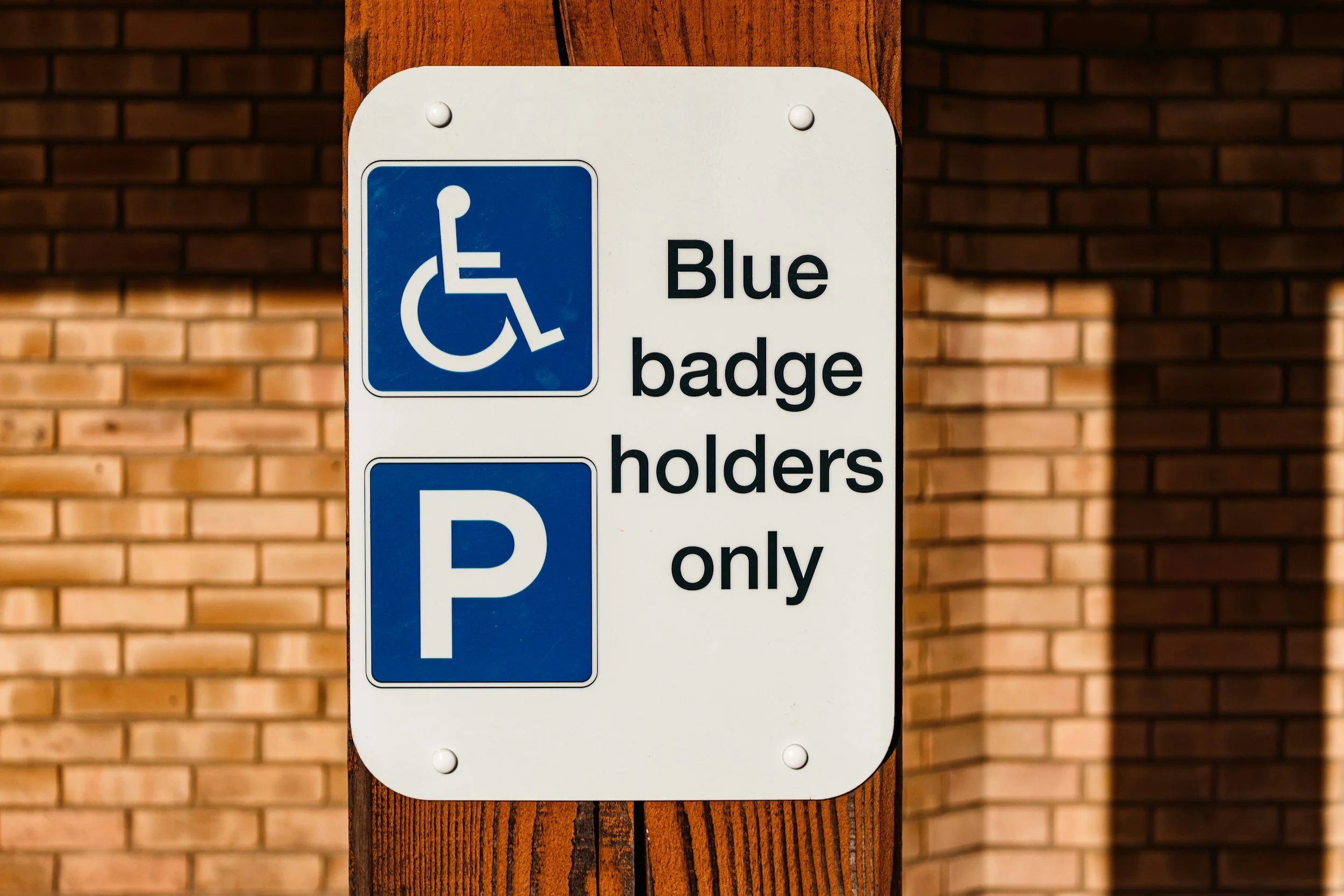
A Blue Badg
e Does Not Mean a Motability Car
Blue Badge + Motability car + disabled parking
There is something I seem to be saying more and more lately, particularly when I read comments underneath stories on social media or in the media.
A Blue Badge does not mean the car is a Motability car.
I keep seeing the same assumption being made. Somebody sees a car parked in a disabled parking space with a Blue Badge displayed on the dashboard and immediately assumes that the car must have come through the Motability Scheme.
It has reached the point where I think this is something worth talking about properly because there seems to be a genuine misunderstanding around the Blue Badge scheme, PIP, Motability and disabled parking in the UK.
They are connected in some circumstances, but they are not the same thing.
I know this might seem obvious if you are disabled yourself and have had to navigate these systems, but from the comments I regularly read online, it clearly is not obvious to everyone.
Living with ME CFS and fibromyalgia has taught me just how many assumptions people make about disability from the smallest amount of information.
A Blue Badge on a dashboard is one of them.
My Blue Badge Does Not Tell You Who Owns My Car
This is probably the simplest way I can explain it.
If somebody sees my Blue Badge displayed in a car, that badge tells them that I am entitled to use the parking concessions available to me as a Blue Badge holder.
It does not tell them how the car was bought.
It does not tell them who owns the car.
It does not tell them whether the car is leased.
It does not tell them whether it came through Motability.
It does not tell them my complete benefit entitlement.
It certainly does not give somebody looking through the windscreen a complete picture of my disability.
The Blue Badge scheme exists to help disabled people and people with qualifying health conditions park closer to where they need to go.
For me, that distance matters.
With ME CFS and fibromyalgia, I do not think about distance in quite the same way I once did.
A few extra metres are not always just a few extra metres.
They can be additional pain. They can be additional crushing body fatigue. They can mean standing for longer than my body can comfortably manage. They can take more from an already limited amount of energy.
Sometimes I can make it into a shop but know I still have to get back to the car afterwards. Sometimes the journey back feels considerably longer than the journey in.
That is part of living with fluctuating chronic illness that people cannot necessarily see.
It is also why accessible parking can make such a difference.
A Blue Badge And The Motability Scheme Are Not The Same Thing
This is where I think a lot of the confusion comes from.
In England, Blue Badges are administered by local authorities. There are eligibility criteria, including routes where certain benefits or mobility scores can establish eligibility, but people can also qualify following an assessment of their circumstances.
Motability is something different.
The Motability Scheme allows eligible disabled people receiving a qualifying mobility benefit from the DWP to use that benefit to lease a car, powered wheelchair or mobility scooter.
So although there can be an overlap between people who qualify for a Blue Badge and people who qualify for the Motability Scheme, one does not automatically mean the other.
I can have a Blue Badge and use it in my own privately owned car.
I can use my Blue Badge when somebody else is driving me, provided the journey is for me and the badge is being used correctly.
Having a Blue Badge does not somehow turn whichever vehicle I am travelling in into a Motability vehicle.
That distinction matters because I see people making judgements based on the assumption that it does.
Why I Keep Seeing This Assumption Online
I have lost count of the number of comments I have read where somebody talks about a car parked in a disabled space and another person immediately refers to it as a Motability car.
Sometimes the conversation is about the make of the car.
Sometimes it is about how new the car looks.
Sometimes somebody has decided that the car is too expensive, too sporty, too large or simply too nice for a disabled person to have.
That is usually where the assumptions begin.
There is a Blue Badge on the dashboard, therefore it must be a Motability car.
Except that is simply not something anyone can know from seeing a Blue Badge.
The person may have bought that car themselves.
They may have owned it before becoming disabled.
It may belong to their partner.
It may belong to a family member who is driving them.
It may be a Motability vehicle, but the Blue Badge itself does not tell anybody that.
This is why I think language matters.
If I do not actually know something, I try not to present my assumption as fact.
Disabled people already spend enough time having their lives assessed without strangers conducting their own assessment in a supermarket car park.
Disability Does Not Come With A Certain Type Of Car
There is another layer to this that bothers me.
Sometimes I get the impression that people have a picture in their head of what a disabled person's car should look like.
Apparently disability is supposed to come with a particular type of vehicle.
I have never quite understood that.
Disabled people have jobs. Disabled people have families. Disabled people save money. Disabled people buy cars. Disabled people inherit cars. Disabled people have partners who own cars. Disabled people can like cars.
We do not suddenly lose every other part of our identity because our health changes.
I live with ME CFS and fibromyalgia, but those conditions do not dictate what colour car I am allowed to sit in or what badge should be on the bonnet.
More importantly, nobody can work out how disabled I am by looking at the vehicle I have arrived in.
That is one of the things I wish more people understood about living with invisible chronic illness and fluctuating disability.
Living With ME CFS Means I Have To Think About Energy Differently
For me, accessible parking is not about convenience.
It is part of managing what my body can actually do.
Living with ME CFS means I am constantly aware that energy is not an unlimited resource. Fibromyalgia adds another layer because pain itself is exhausting.
Walking across a large car park can take something from me that another person might not even notice.
That does not necessarily mean I cannot walk.
This is another misconception I come across.
Using a disabled parking space does not mean somebody must be completely unable to walk.
For some of us, the issue is how far we can walk safely and repeatedly, what that walking costs us afterwards, how much pain it causes and whether doing it leaves enough capacity for whatever we actually left the house to do.
That last part matters enormously to me.
There is very little point in using most of my available energy getting from the far end of a car park to the entrance if I then have nothing left for the reason I went out.
My life involves choices like that all the time.
Do I have enough energy to shower before going out?
How far will I need to walk?
Will there be somewhere to sit?
How long am I likely to be there?
Can I manage the journey home?
What will tomorrow look like if I do too much today?
These calculations have become such an ordinary part of my life that I sometimes forget other people do not have to make them.
A Blue Badge can remove one small piece of that calculation.
It cannot remove my ME CFS.
It cannot remove my fibromyalgia.
It cannot guarantee that I will be well enough to go somewhere.
What it can sometimes do is reduce an unnecessary physical demand.
That matters.
A Good Day Does Not Cancel Out My Disability
Another problem with judging people in disabled parking spaces is that chronic illness can fluctuate enormously.
There are days when I look more capable than I feel.
There are days when I can walk further.
There are days when I cannot.
There are days when pain is the biggest problem and days when the crushing exhaustion of ME CFS takes over everything.
There are also days when I can do something, but doing it comes with consequences later.
That is something I have written about before when discussing what post exertional malaise feels like when living with ME CFS.
People usually see the activity.
They rarely see the recovery.
Someone might see me get out of a car and walk into a shop.
They do not see what happened before I left home.
They do not know how much energy it took to get dressed.
They do not know what else I have had to cancel.
They do not know whether I will be lying down with crushing fatigue and pain for the rest of the afternoon.
They do not know whether symptoms will increase later.
That is the problem with making assumptions from a few seconds in a car park.
You are seeing a snapshot.
I am living the whole day.
Not Every Blue Badge Holder Receives The Same Benefits
I also think it is worth understanding that Blue Badge eligibility and benefit entitlement are not identical.
Some people qualify for a Blue Badge automatically because they meet certain criteria connected with qualifying benefits or awards.
Other people can apply and have their eligibility considered by their local authority based on the difficulties they experience.
That distinction is important.
It means seeing a Blue Badge does not allow somebody to work backwards and confidently determine everything that person receives.
I sometimes think disability benefits are discussed online as though there is one enormous package that every disabled person receives.
There is not.
Different schemes have different eligibility criteria and different purposes.
PIP is not the Blue Badge scheme.
A Blue Badge is not a Motability car.
Motability is not automatically available to every Blue Badge holder.
They are separate things, even though there can be overlap between them.
Why This Matters Beyond Getting The Terminology Right
I am not writing this simply because I want people to use the correct terminology.
I think the misunderstanding contributes to something bigger.
It feeds the idea that disabled people can be assessed from the outside.
Nice car, therefore not really struggling.
Walking, therefore does not need a disabled space.
Young, therefore cannot be disabled.
Looks well, therefore cannot be ill.
Blue Badge, therefore Motability car.
Every one of those assumptions takes a complicated human life and reduces it to something somebody thinks they understand after looking for a few seconds.
Living with invisible illness has made me very aware of how unreliable appearances can be.
I know what it is like to look relatively normal while my body feels anything but normal.
I know what it is like to calculate whether I can manage a short walk that would once have required no thought at all.
I know what it is like to have pain that nobody around me can see.
I know what it is like to have ME CFS fatigue that is so much more than being tired, yet have no obvious outward sign explaining what is happening inside my body.
That is why I am cautious about judging another disabled person from appearances.
I know how little the outside can tell you.
Disabled Parking Is About Access
This is what I think gets lost in so many online arguments.
Accessible parking is about access.
For me, parking closer can be the difference between being able to do something and deciding that the physical cost is simply too high.
It can preserve a little energy.
It can reduce pain.
It can make getting back to the car easier when my body has reached its limit.
It can make an ordinary task slightly more manageable.
It can help me get out and in the car with the door fully open.
None of that has anything to do with whether the vehicle I am travelling in was privately purchased, financed, borrowed from somebody in my family or supplied through the Motability Scheme.
The Blue Badge belongs to the eligible person, not to one particular car.
That is an important distinction.
I Wish We Were A Little Slower To Judge
Living with chronic illness has changed the way I look at other people.
I am much more aware now that I rarely know the full story.
If I see somebody walking from a disabled parking space, I do not know how far they can walk.
I do not know what walking costs them.
I do not know whether they have a heart condition, neurological condition, chronic pain condition, respiratory condition, ME CFS, fibromyalgia or another disability I cannot see.
I do not know whether they will be able to walk that same distance tomorrow.
I do not know what their body will make them pay for today's activity later.
I certainly cannot determine their entire financial situation or benefit entitlement from the car they arrived in.
Sometimes we simply do not know.
I wish saying that was more acceptable.
A Blue Badge Tells You Far Less Than You Think
So when I see another comment online referring to a vehicle as a Motability car purely because there is a Blue Badge displayed, I will probably keep correcting it.
Not to be awkward.
Not to start an argument.
Simply because it is incorrect.
A Blue Badge does not mean a Motability car.
A person can have a Blue Badge without having a Motability vehicle.
A person can travel in different vehicles and use their badge appropriately because the badge is there to support the disabled person's access.
Most of all, a Blue Badge is not an invitation for strangers to make assumptions about somebody's health, finances, benefits or disability.
For me, mine represents something much more ordinary.
It helps me manage a life made smaller and more complicated by ME CFS and fibromyalgia.
It helps me save a little energy and pain where I can.
It helps reduce walking when walking has a cost.
It gives me a slightly better chance of doing the thing I actually left home to do.
That is all somebody really needs to know when they see it on the dashboard.
The rest of my story cannot be read through the windscreen.
About me
I am a married mother of four children. One of those four children is our granddaughter, for whom we are SGO (legal guardians)/kinship carers. I run a small business and enjoy writing, so I blog. My blog focuses on my family life as well as my experiences of living with chronic illnesses and disabilities such as ME/CFS, spinal stenosis, chronic pain, and fibromyalgia. Oh, and I am only in my mid-40s.
Frequently Asked Questions About Blue Badges And Motability
-
No. Having a Blue Badge does not mean my car is a Motability car. A Blue Badge and the Motability Scheme are separate things. My Blue Badge helps me access disabled parking concessions, but it does not tell anyone how the car I am travelling in was bought, financed or provided.
-
No. In England, Blue Badges are administered by local councils. Some people automatically qualify because of certain benefits or mobility awards, while other people can qualify after their circumstances have been assessed by their local council.
-
No. The Motability Scheme is separate from the Blue Badge scheme. Eligible disabled people receiving a qualifying mobility allowance can choose to use that allowance to lease a vehicle through the Motability Scheme. My local council does not provide a Motability car simply because I have been issued with a Blue Badge.
-
Yes. This is one of the biggest misunderstandings I see online. I can qualify for a Blue Badge without having a Motability vehicle. Seeing a Blue Badge displayed inside a car does not tell somebody whether that vehicle is privately owned, financed, borrowed or leased through Motability.
-
Yes, provided the badge is being used for me and in accordance with the Blue Badge rules. A Blue Badge belongs to the eligible person rather than being permanently attached to one particular vehicle. This means I can use my badge when somebody else is driving me, where the journey and parking are for my benefit.
-
Not necessarily. Some PIP awards can provide automatic eligibility for a Blue Badge, depending on the points awarded for particular activities. There are also people who may be eligible for a Blue Badge without qualifying automatically through PIP. This is why I think it is important not to assume somebody's benefit entitlement simply because I see their Blue Badge.
-
No. Blue Badge eligibility and Motability eligibility are different. Having a Blue Badge by itself does not give me access to the Motability Scheme. Motability eligibility depends on receiving one of the qualifying mobility allowances at the required level and having sufficient time remaining on the award.
-
Yes. Not every disability or health condition affecting mobility is visible. This is particularly important to me as somebody living with ME CFS and fibromyalgia. Being able to walk from a disabled parking space does not tell somebody how far I can walk, how much pain I am experiencing, how much energy that activity requires or what the consequences might be afterwards.
-
For me, reducing unnecessary walking can make an enormous difference. ME CFS and fibromyalgia can affect my energy, pain levels and ability to manage physical activity. Parking closer can help me conserve some of my limited energy for the reason I actually left home. It is not about convenience. It is about making everyday life a little more accessible and manageable.
-
No. A car being parked in a disabled parking space with a Blue Badge displayed does not prove that it is a Motability vehicle. That is the assumption I wish more people would stop making. A Blue Badge tells you that an eligible badge holder is using it. It does not tell you their complete circumstances, their benefit entitlement or how the vehicle was obtained.


Autumn can be beautiful, but colder weather and darker days can make living with ME/CFS and fibromyalgia more challenging. Here are ten gentle self-care tips for managing your energy, pain and wellbeing as the season changes.