
My First Cruise with ME/CFS and Fibromyalgia: What I Expected Versus What Actually Happened
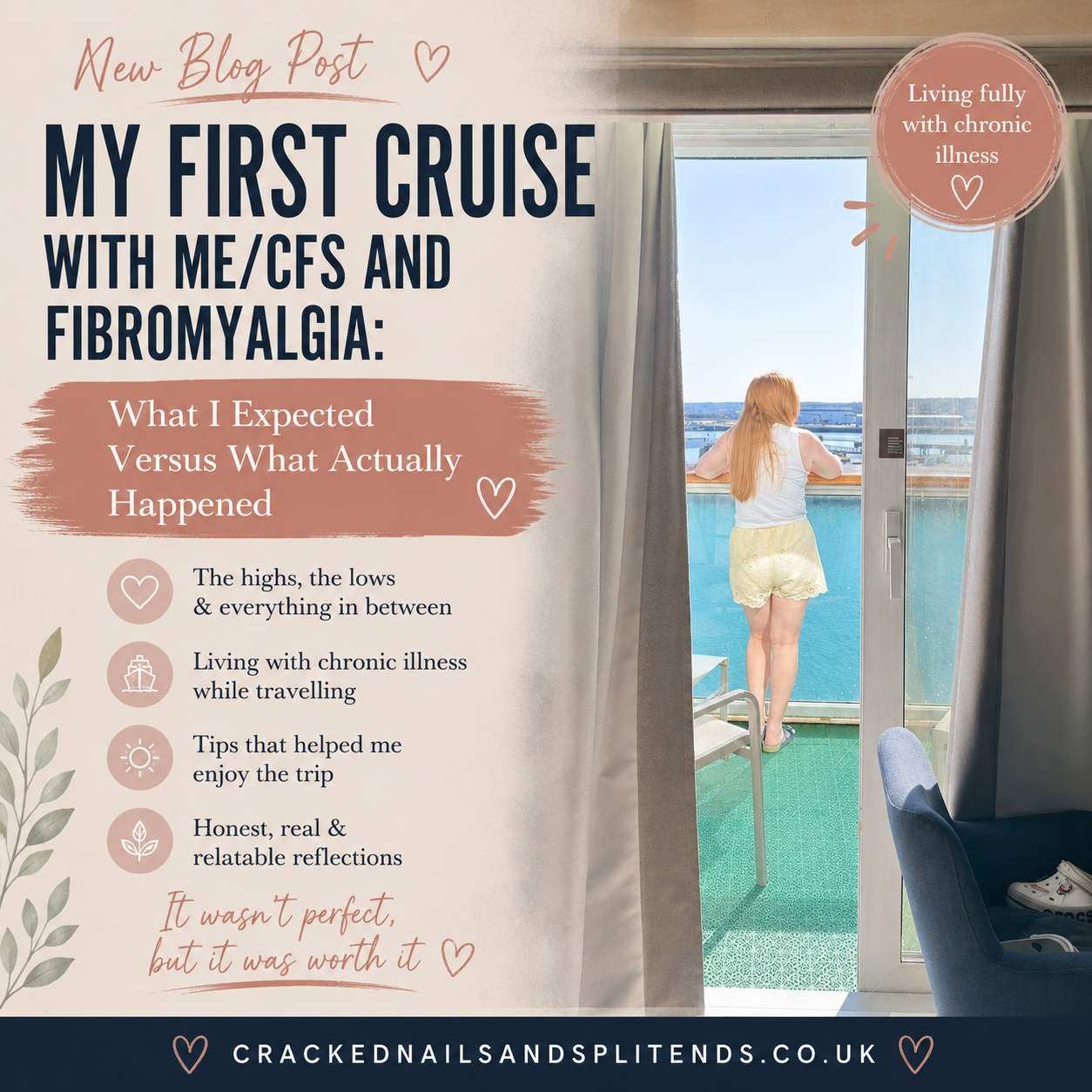
For years, I had been curious about cruises.
The idea always sounded appealing to me. A floating hotel that takes you from place to place without the hassle of constantly packing and unpacking, long travel days, or navigating unfamiliar transport systems. Living with ME/CFS and fibromyalgia means I have to think carefully about how I travel, and a cruise seemed like it might offer a gentler way to see different places while still allowing me plenty of opportunities to rest.
At the same time, I was nervous.
None of us knew whether we would actually enjoy it. Most of my children experience travel sickness, so there was a fair bit of uncertainty before we even stepped on board. I spent weeks wondering if we were making a mistake and whether we would spend the entire holiday feeling ill.
As it turned out, the travel sickness situation unfolded in a way none of us expected.
The Travel Sickness Plot Twist
Before leaving, I packed plenty of travel sickness wristbands and patches. Experience has taught me that it is always better to have too much than not enough, especially when travelling with children.
Ironically, the children handled the cruise far better than I did.
I had gone into the holiday expecting at least one of them to struggle with the movement of the ship, yet they adapted incredibly quickly. My daughter experienced a little sickness, but the patches worked well for her and she was able to enjoy the rest of the holiday without too much disruption.
I was the one who ended up feeling the effects the most.
On the ship itself, I managed reasonably well with the help of the sickness aids I had brought with me. It was only when we returned home that I experienced something I had never dealt with before.
Sea legs.
I had heard people mention them, but never really understood what they meant.
The day after arriving home, it genuinely felt as though my house was moving. Every room seemed to sway as though I was still onboard. Even standing still felt strange because my body seemed convinced it was still at sea.
Out of everything that happened during the cruise, this probably made me feel the worst.
Thankfully, it only lasted about a day before settling down, and I gradually returned to normal. Well, normal for me anyway.
Why I Thought a Cruise Would Be Ideal for ME/CFS
One of the biggest reasons I wanted to try cruising was because I believed it would be a calmer, slower paced way to travel.
When you live with chronic illness, accessible holidays become incredibly important. I cannot approach travel in the same way I did before ME/CFS and fibromyalgia became part of my everyday life.
Energy management becomes a major factor.
I often have to plan for rest before activities, rest during activities, and rest after activities. It is not exactly spontaneous.
A cruise seemed like it would remove some of the pressure.
I imagined quiet mornings, plenty of places to sit, relaxing sea views, and the ability to retreat to my cabin whenever I needed to.
In some ways, that was exactly what it offered.
In other ways, it was completely different from what I expected.
The Surprising Amount of Walking
One thing nobody had really prepared me for was just how much walking is involved on a cruise ship.
Cruise ships are enormous.
To get from the cabin to a restaurant could involve a considerable walk. Going to a swimming pool, a theatre show, an activity area, or another venue often meant covering much more distance than I had anticipated.
For somebody without mobility challenges, this may not seem like a big deal.
For somebody living with ME/CFS and fibromyalgia, it can make a significant difference.
Every unnecessary step adds up.
Every corridor becomes a little longer.
Every journey back to the cabin requires more energy than you'd expect.
There were several occasions where I found myself surprised by how much my body was struggling simply because I had underestimated the cumulative impact of all that movement.
This was probably my biggest lesson from the entire cruise experience.
The Hidden Cost of Pushing Through the Pain
What I had not fully anticipated was how much pain the cruise would leave me trying to manage each day. The walking was one thing, but for me, walking is never just walking. Every extra step comes with a cost. As the days went on, my fibromyalgia pain levels steadily increased, and the familiar deep aching, burning sensations and heaviness started to build. There were moments when I wanted nothing more than to stop, sit down, and rest properly, but family holidays are precious, and I did not want my children to feel as though they were missing out because of my health.
Like many people living with chronic illness, I became very good at grinning and bearing it. I pushed myself through activities, smiled through conversations, and did my best to mask how much discomfort I was actually in. What many people do not realise is that masking symptoms is exhausting in itself. It is not just the physical effort of carrying on when your body is hurting. It is the mental effort of constantly monitoring your expressions, your tone of voice, and your reactions so the people around you do not see how much you are struggling. By the end of some days, I was not only physically drained from the pain and walking, but emotionally exhausted from trying to hide it. Looking back, that invisible effort probably used almost as much energy as the activities themselves.
For those of us living with ME/CFS and fibromyalgia, there is often a fine line between making memories and paying for them later. This cruise was a reminder that even when I appear to be coping on the outside, there is often a very different reality happening behind the scenes.
Rest Days Are Not Optional
One thing I have learned over the years is that pushing through never ends well.
No matter how exciting the holiday is, my body eventually reminds me of its limits.
There were several days during the cruise when I stayed in the cabin whilst my husband took the children off to explore the ship or enjoy activities.
This was actually another reason why I wanted to experience a cruise.
When travelling with ME/CFS, I know there will often be moments when I simply cannot participate. Having a holiday option where my family could still enjoy themselves without me felt important.
The reality was exactly that.
They could go swimming, attend activities, explore the ship, grab food, or simply wander around while I rested in bed.
Knowing they were still having fun removed a lot of the guilt that can sometimes accompany chronic illness.
Parents with chronic illness often carry an invisible weight. We worry about missing moments. We worry about holding our children back. We worry about disappointing them.
Being able to rest while knowing they still had plenty to do gave me a level of reassurance that traditional holidays do not always provide.
Travelling with Teenagers Is a Whole Different Challenge
My children are both teenagers now, which comes with its own unique set of challenges.
They are old enough to want independence, but still young enough to rely on us for entertainment.
They enjoyed the cruise overall, but there were moments when boredom crept in.
I think this is probably one of those funny stages of parenting where almost any holiday will have moments of enthusiasm mixed with moments of complete indifference.
One minute they are excited.
The next minute they are asking what there is to do.
Five minutes later they are back to enjoying themselves again.
I suspect many parents of teenagers will understand exactly what I mean.
Accessibility Made a Huge Difference
One of the biggest positives of the entire experience was the accessibility support.
Embarkation was far easier than I had expected.
We had accessibility arrangements in place, and from the moment we arrived, staff greeted me with a wheelchair.
Rather than standing in long queues or navigating complicated boarding procedures, I was assisted through the process and taken directly to our room.
That support immediately reduced a huge amount of stress and energy expenditure.
When living with energy limiting illnesses such as ME/CFS, small accessibility adjustments can have an enormous impact.
What might seem like a minor convenience to one person can mean the difference between starting a holiday exhausted or actually having some energy left to enjoy it.
The accessibility team absolutely deserve credit for that.
When Anxiety Becomes Part of the Holiday
One thing I had been particularly excited about was having a balcony cabin. Part of the reason I wanted to try a cruise was to experience being out at sea properly. I imagined sitting quietly watching the waves, enjoying the sunsets, and spotting wildlife from the comfort of our own balcony. In many ways, it lived up to those expectations. We saw plenty of dolphins during the trip, which felt incredibly special, and at one point we even spotted a French Navy submarine, which was definitely not something I had expected to see whilst on holiday.
The difficulty was that I also live with a fear of falling, and I had not really considered how much that would affect my ability to enjoy the balcony. Although the glass barriers were perfectly safe, my brain did not always agree. Leaning against the glass to look out at the sea made me feel surprisingly anxious. Rather than relaxing into the experience, I often found myself feeling tense and hyper aware of my surroundings. As the holiday went on, that anxiety seemed to build rather than settle. By the final day, we were lying on sun loungers near the back of the ship with our heads positioned close to one of the large glass barriers. Everyone else was happily relaxing, but internally I was silently panicking. No matter how irrational it may have been, there was a constant voice in the back of my mind convincing me that somehow we could just tip out. I knew logically that was not going to happen, but anxiety is not always logical. It was frustrating because I wanted so much to fully enjoy those moments and the incredible views around me, yet part of my energy was being spent managing the fear that came with them. Living with chronic illness often means dealing with physical symptoms, but sometimes it is the anxiety and mental load that quietly steal enjoyment from experiences too.
My Walking Stick and What I Learned
I took my walking stick with me, and I am glad I did.
There is no way I could have managed some of the distances without it.
That said, I also discovered that it sometimes got in the way.
Navigating busy areas, restaurants, lifts, and narrow spaces occasionally felt more awkward than I expected.
It highlighted something I have been considering for a while.
I really need to invest in a fold away walking stick.
Being able to store it more easily when I do not need it would make travelling far more practical in the future.
Living with limited mobility means my needs can change from one hour to the next, and a more flexible solution would probably suit me much better.
Would I Go on Another Cruise?
This is the question everyone asks.
The honest answer is probably not.
I am genuinely pleased we tried it.
I enjoyed the experience.
The children enjoyed the experience.
There were many positives, particularly around accessibility, the ability to rest when needed, and not having to organise transport between destinations.
At the same time, it was far more physically demanding than I had imagined.
The amount of walking caught me off guard, and despite my expectations of a slow paced holiday, I found myself using more energy, and there was more pain than anticipated.
That does not mean cruises are unsuitable for people with ME/CFS or fibromyalgia. Far from it.
Every person experiences these conditions differently.
What works brilliantly for one person may not work for another.
For me, trying the cruise was valuable because it helped me better understand what types of travel suit my body.
Sometimes the only way to know is to try.
What This Experience Taught Me About Chronic Illness Travel
If there is one thing chronic illness continually teaches me, it is the importance of adapting expectations.
Success no longer means doing everything.
Success means finding ways to enjoy experiences whilst working within my limits.
This cruise reminded me that rest is productive.
Accessibility matters.
Mobility aids are tools, not failures.
Most importantly, memorable family holidays do not require me to participate in every single moment.
Sometimes the best thing I can do is listen to my body, step back, recharge, and allow everyone else to continue making memories until I am ready to join in again.
That is not giving up.
That is living alongside ME/CFS and fibromyalgia in the most realistic way possible.
About me
I am a married mother of four children. One of those four children is our granddaughter, for whom we are SGO (legal guardians)/kinship carers. I run a small business and enjoy writing, so I blog. My blog focuses on my family life as well as my experiences of living with chronic illnesses and disabilities such as ME/CFS, spinal stenosis, chronic pain, and fibromyalgia. Oh, and I am only in my mid-40s.
Further Reading on Travelling with Chronic Illness
If you're navigating holidays and days out with ME/CFS, fibromyalgia, chronic pain or fatigue, you may also find these posts helpful:
FAQ Section
-
In some ways, yes. I found that having access to my cabin throughout the day made it easier to rest when I needed to. It also meant my family could continue enjoying activities while I recovered. However, I was surprised by how much walking was involved, both on the ship and during port visits. For me, it was far more physically demanding than I expected.
-
It did, but not in the way I anticipated. I expected my children to struggle because they are prone to travel sickness, but they actually coped very well. I was the one who felt it most. Travel sickness bands and patches helped, and my daughter found the patches particularly useful. The biggest challenge came after returning home when I experienced sea legs and felt like my house was still moving.
-
Sea legs are the sensation of still feeling movement after leaving the ship. The day after I got home, it genuinely felt as though my house was swaying. It was quite unsettling and probably made me feel worse than the motion of the ship itself. Fortunately, the sensation only lasted about a day.
-
The accessibility support was excellent. During embarkation, I was provided with a wheelchair and assisted straight to our cabin. This saved a significant amount of energy and reduced stress. For anyone living with chronic illness or mobility challenges, I would strongly recommend contacting the cruise line's accessibility team before travelling.
-
Yes, I took my walking stick with me and was very glad I did. The distances around the ship were much greater than I expected. My walking stick helped me manage, although it occasionally felt awkward in busy areas. The experience convinced me that I need a fold away walking stick for future trips.
-
Yes. The combination of walking, activities, port visits and simply trying to keep up with family life increased my pain and fatigue levels. I found myself masking how much I was struggling so my children could enjoy their holiday. By the end of some days, I was exhausted not only from the physical exertion but from hiding how much pain I was actually in.
-
One of the things I looked forward to most was having a balcony cabin. I wanted to watch the waves, see the sunsets, and enjoy the wildlife. We were lucky enough to see dolphins and even a French Navy submarine. Unfortunately, my fear of falling made it difficult to fully relax. Although I knew the balcony glass barriers were safe, my anxiety often overruled logic, and it became harder to enjoy those spaces as the holiday went on.
-
Probably not, although I am very glad we tried it. The experience taught me a lot about how my body copes with different types of travel. While there were many positives, especially around accessibility and flexibility, the overall physical demands were greater than I expected. I have no regrets, but I think other forms of travel may suit my particular health needs better.

Autumn can be beautiful, but colder weather and darker days can make living with ME/CFS and fibromyalgia more challenging. Here are ten gentle self-care tips for managing your energy, pain and wellbeing as the season changes.